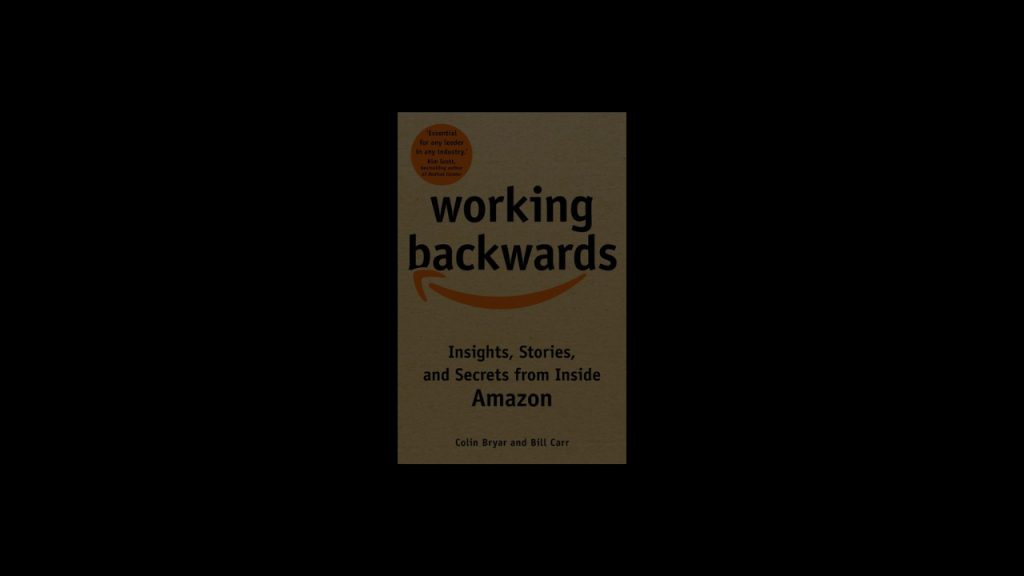
Working Backwards came out in 2021, written by Colin Bryar and Bill Carr, two people who were genuinely inside the room for the Amazon practices everyone now name-drops. Bryar spent 12 years at Amazon, several of them as Jeff Bezos’s chief of staff (his “shadow”) sitting in on nearly every meeting Bezos ran. Carr was VP of Digital Media, building out Amazon Music, Prime Video, and Amazon Studios, so he was on the other side of the table building the products, not just watching the process. That combination is what makes the book worth reading.
The Amazonian Principles
- Customer Obsession: start with the customer and work backwards, earning trust rather than assuming it
- Ownership: think long term, act like you own the outcome, never say “not my job”
- Invent and Simplify: expect innovation from your team and simplify relentlessly, even if it means being misunderstood for a while
- Are Right, A Lot: strong judgment, actively sought-out diverse views, and a habit of testing your own beliefs rather than defending them
- Learn and Be Curious: never finished learning, never finished improving
- Hire and Develop the Best: raise the bar with every hire, and develop the talent you already have
- Insist on the Highest Standards: demand quality, and don’t let defects quietly ride along
- Think Big: set a direction bold enough to actually inspire people, not just fill a slide
- Bias for Action: most decisions are reversible; move faster than the planning cycle wants you to
- Frugality: do more with less, and treat constraints as a feature, not a bug
- Earn Trust: listen, speak plainly, treat people with real respect
- Dive Deep: stay close to the details, check the data yourself, don’t take the summary’s word for it
- Have Backbone then Disagree and Commit: push back hard before the decision, then commit fully once it’s made
- Deliver Results: focus on the inputs you control, and deliver, setbacks included
Every well-known mechanics that companies copy exists to enforce one of them. e.g. The PR/FAQ exists to enforce “Customer Obsession” before a single line of code gets written.
PR/FAQ + 6-pager
The PR/FAQ and the 6-pager are the two ideas that spread the fastest, because they’re formats. You can hand someone a template and say “do this.” The key thing to note is that this exercise is a filter, not a planning doc. A team writes the press release, discovers the product doesn’t have a customer story worth telling and the feature gets killed.
Teams I’ve worked in have ever adopted the format skip and ship it anyway because the sprint’s already planned and the roadmap review is Thursday. Done this way, we ended up with a beautifully formatted press release for a product nobody asked for. The enforcement of an go/no-go decision was missing.
Single-threaded leadership gets the same treatment. Everybody likes the idea of “one owner, no split attention.” Almost nobody likes what it actually costs. The book is honest that Amazon paid real friction costs to run teams this way.
My Favourite Strategic Shifts
The first is the Bar Raiser program. A hiring interviewer, deliberately pulled from outside the hiring manager’s own team, whose only job is to protect the bar and who holds veto power over the hire. The person with the least incentive to fill the seat quickly is the person with the power to block it. In my experience, team do this to a varying extent with a cross-team interview but usually framed to assess for “culture fit” and often do not hold veto rights.
The second is what the book calls controllable input metrics: tracking the things your team actually controls (send frequency, page load time, number of qualified touchpoints) instead of the output everyone reports on (revenue, conversion) that’s downstream of a dozen things you don’t control. Amazon ran Weekly Business Reviews built almost entirely around inputs, with finance auditing the numbers independently so nobody could quietly redefine a metric mid-quarter. Growth marketing loves a dashboard full of outputs. Fewer of us have the harder, less flattering dashboard of inputs, audited by someone who isn’t us.
Contextual Caveat
Bryar was at Amazon from 1998 to 2010, Carr from 1999 into 2014, and most of what they describe is drawn from that stretch a specific company at a specific size, with founder-level authority to force painful trade-offs (kill a beloved project, tell a VP their team’s too big) that most of us can’t force from a growth-marketing seat. The book also doesn’t spend much time on the harder edges of that era’s Amazon culture. This is an insider’s account of how decisions got made, not a warts-and-all history. So it is safer to read this as a strong menu of mechanisms that worked in one very specific, very intense environment, not a universal operating manual.
What I’d actually steal from it
The filter discipline underneath it. If you run growth, you almost certainly have a version of the PR/FAQ already. The question worth borrowing from this book is “does anyone on your team have the actual authority, and the actual willingness, to read that doc and say no”?
A small version of this that doesn’t require Bezos-level authority. Before your next big campaign or paid push gets greenlit, write the customer-facing announcement for it first. If you can’t write a version of that announcement that a customer would care about, you’ve found the weak spot before you’ve spent the budget on it.
Read or Not?
This book is worth reading, the summary won’t do it justice. The mechanics are genuinely well explained, and the book is honest that holding to some of these principles are difficult, designed intentionally and expensive to run. It’s a strong account of what worked for one company at one moment. So, steal the discipline. Take the idea to make high-level principles actionable.
“Good intentions don’t work. Mechanisms do.”
Want to be alerted once a new post is out? Stay “In the Nette”.
[Sign up for In the Nette →]




Leave a comment